

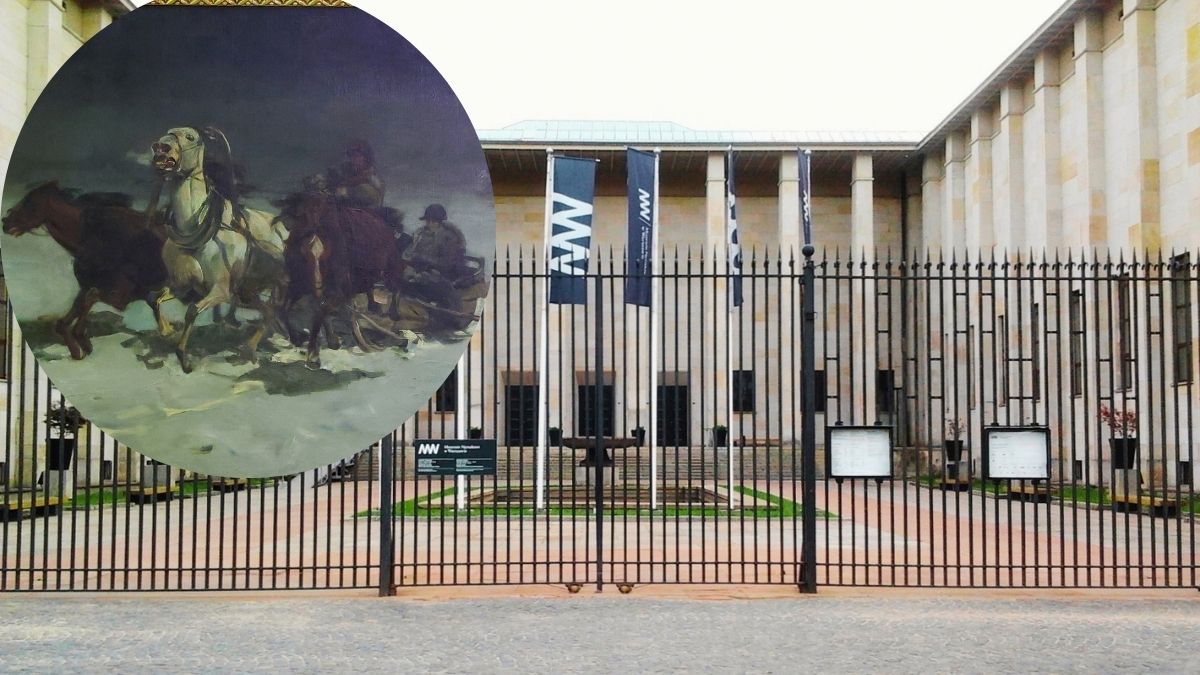
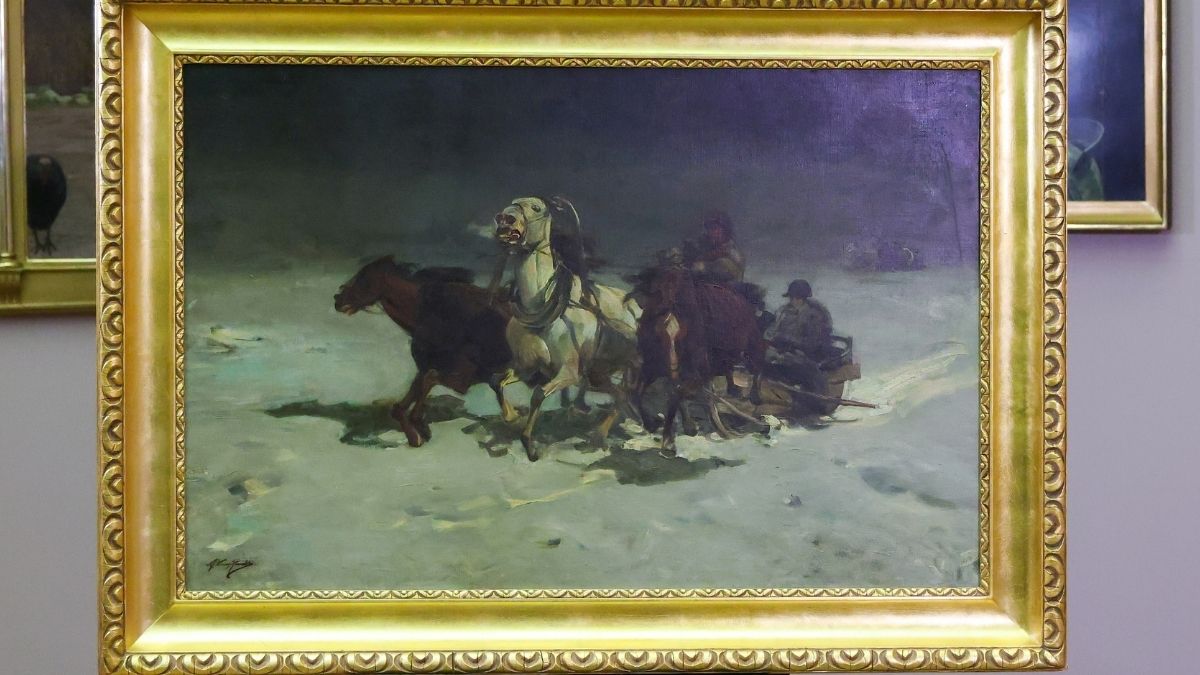
A painting that once decorated an SS officers’ club in occupied Warsaw has entered Poland’s national collection after the woman who owned it investigated its past. Winter – Napoleon’s Retreat from Moscow, by Polish artist Alfred Wierusz-Kowalski, was handed over to the National Museum in Warsaw on 28 September 2026. Its previous owner, Ewa Tsonis, worked with Poland’s culture ministry to arrange the transfer after discovering its wartime history. Behind the official announcement is a personal story: a picture treasured by a family for decades, and a decision to uncover how it had reached them.
The culture ministry’s announcement describes the painting as a particularly valuable recovery among Poland’s wartime losses. Tsonis’s role was central: having discovered its history, she took steps to place it in a public collection. The handover brought together the owner, museum specialists and officials involved in recovering missing cultural property. It also reconnected a work long held in a private home with the documented history of a Polish collection dispersed during the German occupation.
From a Polish collection to an SS officers’ club
Before the Second World War, the painting belonged to Andrzej Rotwand, a banker and engineer whose family assembled an important collection of Polish art. In June 1939, it went on display at Warsaw’s Zachęta gallery. The exhibition was still running when Germany invaded Poland that September. Under occupation, works from the exhibition were moved to the National Museum, but that offered no protection from confiscation. A document dated 15 October 1940 places the painting in Blanka Palace, decorating a club for senior SS and police officials. How it subsequently left the palace remains unclear, according to the Jan Karski Institute of War Losses.
The family who lived with the painting
According to the Jan Karski Institute of War Losses, Tsonis said her father, Michał Stefan Koryzna, bought the work in the 1960s, probably in Kraków. It remained in the family for decades. Research into its origins eventually revealed a history that went far beyond the family’s ownership. She contacted the culture ministry, and specialists from the National Museum confirmed the painting’s identity. It survives in good condition, with its original frame, the culture ministry confirms. Her decision illustrates the importance of provenance research: tracing where an artwork has been and who has owned it can reconnect a familiar possession with a lost chapter of history.
What does the painting show?
The work depicts Napoleon’s retreat from Moscow in 1812, with the defeated army travelling through a harsh Russian winter. The culture ministry describes Wierusz-Kowalski as a leading representative of Polish realism in the second half of the nineteenth century and of the Munich school. His work was exhibited and awarded prizes across Europe. For readers encountering his name for the first time, the recovered painting offers an introduction through a subject familiar far beyond Poland: the collapse of Napoleon’s Russian campaign. Its historical subject is distinct from its later wartime fate; the painting portrays the nineteenth century, while its disappearance belongs to the history of the twentieth. The culture ministry describes the work and the artist’s background.
Other paintings from the same collection are still missing
The recovery leaves part of the story unfinished. Two other works from Rotwand’s collection that also hung in the SS officers’ club—Anna Bilińska’s Italian Woman and Kazimierz Alchimowicz’s Mother with Children—remain missing, according to the culture ministry. For families with Polish connections, these searches concern more than museum inventories: they help reconstruct the collections and cultural life that existed before the occupation. This time, questions about a painting kept in a family home helped bring one of those works into a public collection in Warsaw.
Image credits: painting — Danuta Matloch/MKiDN; museum — BurgererSF / Wikimedia Commons (CC0).